Showing posts with label 50 books challenge. Show all posts

Friday, August 9, 2013

Book review: The Snow Child by Eowyn Ivey

The Snow Child by Eowyn Ivey

The novel I want to write about today is The Snow Child by Eowyn Ivey.  Ivey adapts an old Russian folktale called "Little Daughter of the Snow" in a largely successful attempt to create a more complex understanding of it.

The Snow Child is set in Alaska in the 1920's.  Mabel and Jack are trying to start fresh by setting up a farm in the Alaskan wilderness.  They have always wanted a child, and when they notice that a mysterious young girl is living in the woods, they begin to wonder whether that dream might just come true.

My favorite aspect of the novel were the descriptions of the setting.  The writing is really atmospheric, and it really highlights the gorgeous, rugged setting.  I thought that it really set off the plot, and it felt really seamless, unlike some other books when the descriptions feel like they were just added to increase the word count.

It is a novel that is more character-driven than plot-driven, and I know that's not to everyone's taste, but I still think that it's worth a try, even if it's not the kind of book you would normally read.  Personally, I like character-driven novels.

While I loved the opening parts of the book, I was actually slightly disappointed by the end. Without spoiling it, I think that there were a lot of interesting themes and ideas that weren't satisfactorily resolved.

The last page has the words "Not the End" on it.  I hope this means we aren't looking at a sequel. Even though the ending wasn't perfect, I did like the fact that it felt conclusive.  I think that there are a lot of books out there with unnecessary sequels, or series that get dragged out too long, and I appreciate it when a writer knows when to move on.

Chance of finding it in my imaginary bookstore? 85%

Thursday, August 1, 2013

Book review: The Perks of Being a Wallflower by Stephen Chbosky

The Perks of Being a Wallflower
by Stephen Chbosky
(my own photo)

Summer is a really good chance for me to catch up on reading that I've been meaning to do throughout the year.  I've been meaning to read this book for quite a while.  I'll admit that this was partially due to the movie, even though I haven't seen it yet.

The Perks of Being a Wallflower focuses on Charlie, who goes into his Freshman year of high school shortly after his friend commits suicide.  During the course of the year, he makes new friends, and goes through several rights of passage traditionally associated with the teenage years.

I really liked the book; I thought that it dealt with a lot of different aspects of growing up, and it didn't shy away from more complicated or darker aspects of adolescence.  That being said I would definitely say that it is for older readers, because it deals with a good few mature themes.

The epistolary structure and the writing style gave the novel a really interesting voice.


Chance of finding it in my imaginary bookstore? 85%

Wednesday, June 12, 2013

Book review: The Alchemist by Paulo Coelho

The Alchemist by Paulo Coelho
(my own photo)

"There is a force that wants you to realize your destiny..."

A shepherd called Santiago keeps on having the same dream; a child takes him to the Pyramids and tells him that he will find treasure there.  He goes on a quest to find the treasure, but gets more than he bargained for along the way.

There were several aspects of the novel that I really enjoyed.   The plot moved at a nice pace, and I thought that the story and writing style managed to keep me engaged throughout.

That being said, I did have a few issues with this novel.  This book has a really clear message about fate, destiny and interconnection. I personally don't agree with it, but that isn't my main problem. Coelho seems to be a fan of "telling" his message, as opposed to "showing" it.  I think that the message would have been far more compelling if he had chosen to write about it differently, especially since he starts to "tell" his message in no uncertain terms really early on in the novel.  Maybe this doesn't bother other people as much.

Another issue I had with this book was the fact that so many characters were so fatalistic.  Maybe this is just my personal experience, but people are rarely completely willing to accept that destiny will decide everything, and that they should just go along with it.  Even people who are generally deterministic still try to control their futures, even if it is just an instinctive desire to preserve life. Some of the characters, particularly the more peripheral ones, didn't seem fully-rounded to me.

Chance of finding it in my imaginary bookstore? 60%

Friday, June 7, 2013

Thoughts on: Poetry Reading (with bonus review of Station Island by Seamus Heaney)

Station Island by Seamus Heaney
(my own photo)
I have recently finished reading Seamus Heaney's Station Island.  I was originally planning to write a review, but it just didn't feel right.  I can't exactly review a whole collection of poetry in the same way that I would a novel, and it would take forever to review every single poem.  Instead I'll keep it brief; if you like reading poetry, then you'll enjoy this.

Chance of finding it in my imaginary bookstore? 85%

Reading Station Island lead me to think about how poetry is read.  I read it reasonably quickly, but with hindsight that probably wasn't a great idea.  If you have the time, it's better to have a book of poetry on your bedside table to dip in and out of, as opposed to trying to read it all at once.

Station Island has a very definite structure; it's divided into sections which have different ideas, and there is a progression from one section to the next.  However, it has generally been my experience that poems are read one at a time, often without regard for the order in which they were placed in a collection.  Some poets are more concerned than others about the place of a poem within a collection, and not all poets publish books.  Nonetheless, it does raise some interesting questions about the value of reading a poem outside of the context of the original work.


Tuesday, June 4, 2013

Book review: Evening is the Whole Day by Preeta Samarasan

I got this book a while ago from a friend for my birthday, but I could never find the time to read it.  However, I'm glad I finally did because I really enjoyed it.

The novel tells the story of a wealthy family of Indian extraction living in Malaysia.  As various different aspects of and perspectives on the family's story are explored, the novel also highlights the cultural, historical and political context in which the events took place.

I thought that the story of the family was interesting in itself.  The characters were really fleshed out and complex, and even at the end of the novel there was still no firm division between "good" and "bad" characters.

Before I read this book I didn't know that much about the history or racial politics of that particular part of Asia, and while I don't think that reading one book turns someone into an expert, I do think that I have a better, more complex understanding of certain aspects of another culture.

The writing style was really beautiful, and I really enjoyed the way it was written.  It may have lagged a bit in a few places, but it was great overall.

Chance of finding it in my imaginary bookstore? 85%


Sunday, June 2, 2013

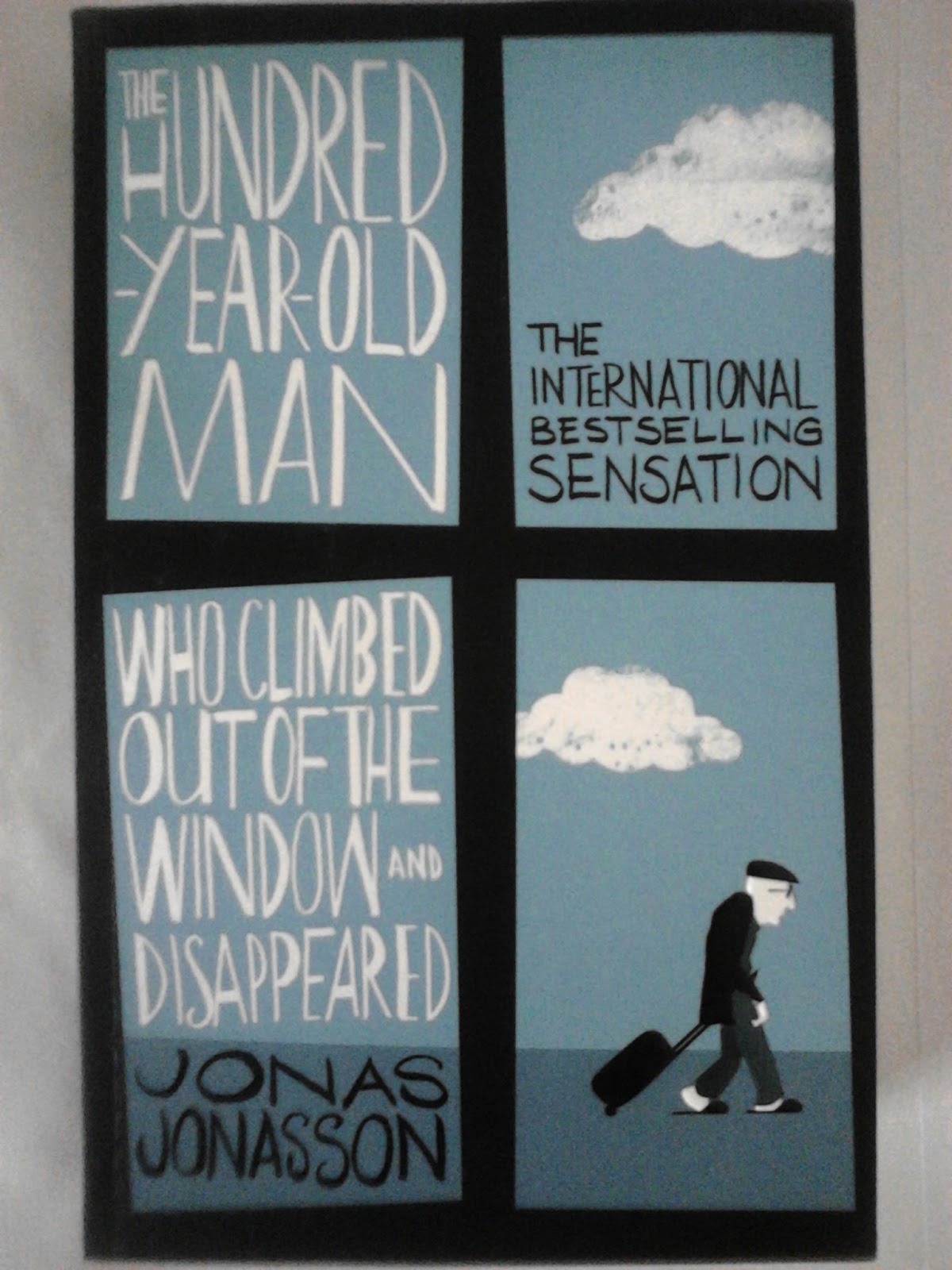
Book review: The Hundred-Year-Old Man Who Climbed Out of the Window and Disappeared by Jonas Jonasson

The Hundred-Year-Old Man Who Climbed Out of the Window and Disappeared by Jonas Jonasson
(my own photo)
Just when you think that you have had enough adventure for a lifetime...

On his one-hundreth birthday, Allan Karlsson decides to leave the old people's home.  He climbs out of the window and embarks on a crazy journey, complete with a runaway elephant, a criminal gang, and an almost-doctor.  The story is intercut with details of Allan's eventful life, and his role in some of the most important events of the twentieth century.

The novel was really funny.  The juxtaposition between Allan's direct, matter-of-fact outlook and the sometimes wacky, sometimes world-changing events he is involved in was very entertaining.

I really enjoyed the characterization of Allan. It's really rare to see an elderly person as the central protagonist of a novel.  More often then not, they're someone's wise mentor, or someone looking back on their eventful, younger years.  Allan was a really fun character, and I enjoyed reading about him.

Chance of finding it in my imaginary bookstore? 95%

Thursday, March 21, 2013

Double Feature: Death of a Salesman and No-one Makes You Shop at Walmart

I just realized that it's almost April, and I haven't written a single post this month.  Even though I'm ridiculously busy right now, I think I'll just get busier as the month goes on.  So, even though I have had absolutely no mind-blowing, incredible, amazing, earth-shattering ideas for posts, I think I'll just write a quick piece on the two books I've read this month so far.

The first one is Arthur Miller's Death of a Salesman.  I absolutely loved this play. The writing was really incredible; it was much shorter than a novel, but every sentence had so much weight. I can't decide whether I prefer this to The Crucible, but I don't think that matters.  When I start comparing work by the same author side by side I always end up not liking one of the texts as much as I had before, because I realize that even though one might be great, it's not quite as good as the other.

Sunday, February 10, 2013

Book review: Thinking Fast and Slow by Daniel Kahneman

Recently, I was quite worried that I was writing too many book reviews, and that I should spend more time on other topics.  However, I have come to the startling realization that I haven't written a review since September.

So, I've decided to review Daniel Kahneman's Thinking Fast and Slow, partially because I saw it on display in the bookshop, and partially because it was released fairly recently, so reviewing it seems slightly less passé.

Thinking Fast and Slow by Daniel Kahneman
(my own photo)
Kahneman's book is based on the idea that while humans are traditionally seen as rational creatures, we do a lot of irrational things.  So far so obvious, but Kahneman does more than just give a list of all the most illogical things we do. His book focuses on psychological research into heuristics, or mental shortcuts, and how they sometimes cause us to make poor decisions.  Much of the research is his own, but it's not the sole focus of the book.

It's really interesting to have someone writing about their own research.  Books that are this accessible to the lay reader are generally written by science writers.  While there is nothing wrong with that, I enjoyed the fact that we got it "straight from the horses mouth".

As I mentioned, the book is aimed at the lay reader, and the language is straightforward.  At the same time, I never got the sense that it was oversimplified or dumbed-down.  Kahneman seems very conscious that his work does have practical implications, and he is very keen to highlight them.

Overall, I thought it was a brilliant book.

That being said, I think that Part IV: Choices dragged a little bit.  It was probably due to the fact that the examples used were so similar, which meant I had several bouts of déjà vu.

Chances of finding it in my imaginary bookstore? 65%

Tuesday, January 1, 2013

New Year’s Resolution: 50 books


 It’s New Year, and that means resolutions.

I know that the whole concept of New Year's Resolutions has become increasingly unpopular.  They don't work, they just make everyone put everything off until January 1st, etc.  However, I remain surprisingly optimistic about them.  January 1st always seems so shiny and new and full of promise, and I really like the idea of having a fresh start. This year I’ve decided to do the fifty books challenge. 

Just like any challenge, it has to have rules.

Rules

1. Read 50 books (insert sarcastic remark here)

1.  Plays, collections of poetry and books of short stories all count, so long as they are at least 90 pages long, not counting any introductions or footnotes.

2. Re-reads don’t count

3. Both fiction and non-fiction works count

I think that it would be ridiculously optimistic of me to suggest that I was also going to write a post on each of these books, but I’m going to start a new page with a list of all of the books I’ve read and a rating.

Happy New Year!