Showing posts with label reviews. Show all posts

Sunday, June 22, 2014

Book Review: How I Live Now by Meg Rosoff

A few months back, I saw How I Live Now, and while there were certain aspects of the film that I enjoyed, it was also really confusing. I concluded that certain parts of the book had been edited out, so, I decided to read it. It turns out the book is better than the movie.

Both the book and the movie tell the story of Daisy, an American teenager who goes to live with relatives in England. There's a war brewing, and it isn't long before England is under occupation. The war changes everything on a macro level, and also serves as the catalyst for the growth of the characters.

I thought that the plot and the representation of war (both of them are closely interconnected) were handled well. The plot moved at a quick pace, but still left enough room for the characters to grow. The occupation was fairly well thought-out, but also managed to differentiate itself from many other depictions of war or life on the home front.

The style of writing, something akin to stream of consciousness, felt intuitive, and it was refreshing to see a writer exploring interesting narrative possibilities, especially in a book that was designed for a wide audience.  While I like more unusual or lyrical styles of narration, I can see how someone who doesn't might not like this.

The characters were well constructed, and even ones that were not central to the plot were still interesting and well-rounded.

Overall, a highly recommended read.

Chance of finding it in my imaginary bookstore? 90%

Wednesday, June 18, 2014

Book Review: Raising Steam by Terry Pratchett


Terry Pratchett's Discworld series is an impressive beast: it totals 40 books, the first of which was published in 1983. Even though I've been a Pratchett fan for a while, I'm still working my way through them.

Raising Steam is the latest installment in the series.  It chronicles the arrival of the railway to Discworld. Dick Simnel, building on the work of his father, manages to harness the power of steam to create the Iron Girder, a prototype of the steam locomotive. With the help of Harry King, and later, Moist von Lipwig, the railway starts criss-crossing the world. However, getting the rest of Discworld on board (I'm sorry) proves to be quite difficult.

Pratchett tends to be a divisive writer: some people love him, others wonder why people read his work, and I don't think this will change any minds.  This novel is definitely in the classic Pratchett style, and, as you are probably able to tell, this is fine by me. This book is still as funny and pertinent as his earlier work.

This novel brings us another installment in the exploits of Moist von Lipwig, Lord Ventari, and Adora Belle Dearheart, among others, and the returning characters are just as charming and fun as usual. Not all of the characters grow and change, but there is still enough character development to keep the story engaging.

The plot is based on an interesting premise.  However, there are some points where it seems to drag a bit, and some of the plot development could have been set up better.

Chance of finding it in my imaginary bookstore? 90%

Monday, June 9, 2014

Book Review: Outliers by Malcolm Gladwell

Outliers by Malcolm Gladwell
(my own photo)
Outliers is the book in which Malcolm Gladwell outlines an idea which is either mindblowing, or mindblowingly obvious.  Simply put, while an individual's success and failures are often put down to talent and determination, more often than not, luck, opportunity and background play a significant, and often ignored, role.

Covering a range of outliers from tech tycoons to professional athletes to the citizens of Roseto, California this book suggests that while these individuals did have attributes that contributed to their success, they also were often fortunate enough to be presented with opportunities not available to their peers, or to have a background that gave them certain advantages. This book is also credited with bringing the 10,000 hour rule into the public consciousness.

I'm not really sure that how qualified I am to judge the actual content of the book: the ideas he puts forward seem to be accurate and well-supported by evidence, but I can't claim to be an expert on the subject matter.

The writing has a nice flow, and he manages to draw together a wide range of data, biographical detail, and other relevant information and communicate it clearly. This means that it is a quick, easy read.  If you agree with the conclusions that he draws, then it can seem a bit unnecessarily repetitive.

Chance of finding it in my imaginary bookstore? 85%


Tuesday, June 3, 2014

Book Review: Mistborn: The Final Empire by Brandon Sanderson

The Final Empire by Brandon Sanderson
(my own photo)
Whether it's The Matrix, Harry Potter, or The Chronicles of Narnia, we all know stories that centre on the "Chosen One/s" attempt to defeat evil. Brandon Sanderson's Mistborn trilogy attempts to examine this trope by exploring a world in which the Chosen One has failed.

The Final Empire is the first book in this series. It focuses on a thieving crew, lead by Kelsier, and their attempt to overturn the Final Empire, a dystopian nation governed by the tyrannical Lord Ruler. The protagonist, Vin, learns that she is a Mistborn.  Mistborns have the ability to use Allomancy, a form of magic that uses metals to activate certain skills, such as becoming stronger and faster, or the ability to soothe other's emotions. Through the use of these capabilities, Vin and the rest of the crew attempt to gather an army, infiltrate the government, set the nobility against each other, and eventually destroy the Lord Ruler.

This book was an enjoyable, faced-paced read, with enough creativity to hold my interest over 643 pages.

The pacing was quick and tight, which means that it was a gripping read.  I also really appreciated the way that the plot was paced in terms of the series as a whole. Although this novel is part of a trilogy, and there is still more story to tell, the book was satisfying and enjoyable on its own. My friend recommended this book to me on the basis of the plot twists, and it delivered on that front.  While there were a few that I saw coming, that may have been due to the fact that I was looking out for them.  It is one of the few novels where you genuinely believe that the main characters could die early on in the series. Overall, the plot was one of the book's strengths.

The world-building was excellent. Many of the supernatural elements in the novel, such as Allomancy, aren't based on any particularly well-known myths and legends, but the ideas are still easy for the reader to follow. Even though there is a glossary at the back, most readers probably won't need to use it.

The book provides an interesting take on the "Chosen One" narrative. Certain elements of Vin's plot seem to be playing this idea fairly straight, but there are plenty of other aspects of the book that subvert this trope. While it is entirely possible to write a compelling "Chosen One" narrative, this idea has become slightly overplayed, and is often written poorly.  It is refreshing to see someone engaging with the idea in a slightly different manner.

That being said, the book isn't perfect.  On the one hand, it seems to be conscious of trying to avoid a simplistic good guy/bad guy dichotomy, it often falls into that trap. There are some characters that seem quite complex at the beginning of the novel, but in the end their actions are explained in a way that allows them to be seen as either entirely "good" or utterly "evil".

While I don't know when I'll be able to read the next book, I'm looking forward to finding out what happens next.
 
Chance of finding it in my imaginary bookstore?  85%

Friday, August 9, 2013

Book review: The Snow Child by Eowyn Ivey

The Snow Child by Eowyn Ivey

The novel I want to write about today is The Snow Child by Eowyn Ivey.  Ivey adapts an old Russian folktale called "Little Daughter of the Snow" in a largely successful attempt to create a more complex understanding of it.

The Snow Child is set in Alaska in the 1920's.  Mabel and Jack are trying to start fresh by setting up a farm in the Alaskan wilderness.  They have always wanted a child, and when they notice that a mysterious young girl is living in the woods, they begin to wonder whether that dream might just come true.

My favorite aspect of the novel were the descriptions of the setting.  The writing is really atmospheric, and it really highlights the gorgeous, rugged setting.  I thought that it really set off the plot, and it felt really seamless, unlike some other books when the descriptions feel like they were just added to increase the word count.

It is a novel that is more character-driven than plot-driven, and I know that's not to everyone's taste, but I still think that it's worth a try, even if it's not the kind of book you would normally read.  Personally, I like character-driven novels.

While I loved the opening parts of the book, I was actually slightly disappointed by the end. Without spoiling it, I think that there were a lot of interesting themes and ideas that weren't satisfactorily resolved.

The last page has the words "Not the End" on it.  I hope this means we aren't looking at a sequel. Even though the ending wasn't perfect, I did like the fact that it felt conclusive.  I think that there are a lot of books out there with unnecessary sequels, or series that get dragged out too long, and I appreciate it when a writer knows when to move on.

Chance of finding it in my imaginary bookstore? 85%

Thursday, August 1, 2013

Book review: The Perks of Being a Wallflower by Stephen Chbosky

The Perks of Being a Wallflower
by Stephen Chbosky
(my own photo)

Summer is a really good chance for me to catch up on reading that I've been meaning to do throughout the year.  I've been meaning to read this book for quite a while.  I'll admit that this was partially due to the movie, even though I haven't seen it yet.

The Perks of Being a Wallflower focuses on Charlie, who goes into his Freshman year of high school shortly after his friend commits suicide.  During the course of the year, he makes new friends, and goes through several rights of passage traditionally associated with the teenage years.

I really liked the book; I thought that it dealt with a lot of different aspects of growing up, and it didn't shy away from more complicated or darker aspects of adolescence.  That being said I would definitely say that it is for older readers, because it deals with a good few mature themes.

The epistolary structure and the writing style gave the novel a really interesting voice.


Chance of finding it in my imaginary bookstore? 85%

Wednesday, June 12, 2013

Book review: The Alchemist by Paulo Coelho

The Alchemist by Paulo Coelho
(my own photo)

"There is a force that wants you to realize your destiny..."

A shepherd called Santiago keeps on having the same dream; a child takes him to the Pyramids and tells him that he will find treasure there.  He goes on a quest to find the treasure, but gets more than he bargained for along the way.

There were several aspects of the novel that I really enjoyed.   The plot moved at a nice pace, and I thought that the story and writing style managed to keep me engaged throughout.

That being said, I did have a few issues with this novel.  This book has a really clear message about fate, destiny and interconnection. I personally don't agree with it, but that isn't my main problem. Coelho seems to be a fan of "telling" his message, as opposed to "showing" it.  I think that the message would have been far more compelling if he had chosen to write about it differently, especially since he starts to "tell" his message in no uncertain terms really early on in the novel.  Maybe this doesn't bother other people as much.

Another issue I had with this book was the fact that so many characters were so fatalistic.  Maybe this is just my personal experience, but people are rarely completely willing to accept that destiny will decide everything, and that they should just go along with it.  Even people who are generally deterministic still try to control their futures, even if it is just an instinctive desire to preserve life. Some of the characters, particularly the more peripheral ones, didn't seem fully-rounded to me.

Chance of finding it in my imaginary bookstore? 60%

Friday, June 7, 2013

Thoughts on: Poetry Reading (with bonus review of Station Island by Seamus Heaney)

Station Island by Seamus Heaney
(my own photo)
I have recently finished reading Seamus Heaney's Station Island.  I was originally planning to write a review, but it just didn't feel right.  I can't exactly review a whole collection of poetry in the same way that I would a novel, and it would take forever to review every single poem.  Instead I'll keep it brief; if you like reading poetry, then you'll enjoy this.

Chance of finding it in my imaginary bookstore? 85%

Reading Station Island lead me to think about how poetry is read.  I read it reasonably quickly, but with hindsight that probably wasn't a great idea.  If you have the time, it's better to have a book of poetry on your bedside table to dip in and out of, as opposed to trying to read it all at once.

Station Island has a very definite structure; it's divided into sections which have different ideas, and there is a progression from one section to the next.  However, it has generally been my experience that poems are read one at a time, often without regard for the order in which they were placed in a collection.  Some poets are more concerned than others about the place of a poem within a collection, and not all poets publish books.  Nonetheless, it does raise some interesting questions about the value of reading a poem outside of the context of the original work.


Tuesday, June 4, 2013

Book review: Evening is the Whole Day by Preeta Samarasan

I got this book a while ago from a friend for my birthday, but I could never find the time to read it.  However, I'm glad I finally did because I really enjoyed it.

The novel tells the story of a wealthy family of Indian extraction living in Malaysia.  As various different aspects of and perspectives on the family's story are explored, the novel also highlights the cultural, historical and political context in which the events took place.

I thought that the story of the family was interesting in itself.  The characters were really fleshed out and complex, and even at the end of the novel there was still no firm division between "good" and "bad" characters.

Before I read this book I didn't know that much about the history or racial politics of that particular part of Asia, and while I don't think that reading one book turns someone into an expert, I do think that I have a better, more complex understanding of certain aspects of another culture.

The writing style was really beautiful, and I really enjoyed the way it was written.  It may have lagged a bit in a few places, but it was great overall.

Chance of finding it in my imaginary bookstore? 85%


Sunday, June 2, 2013

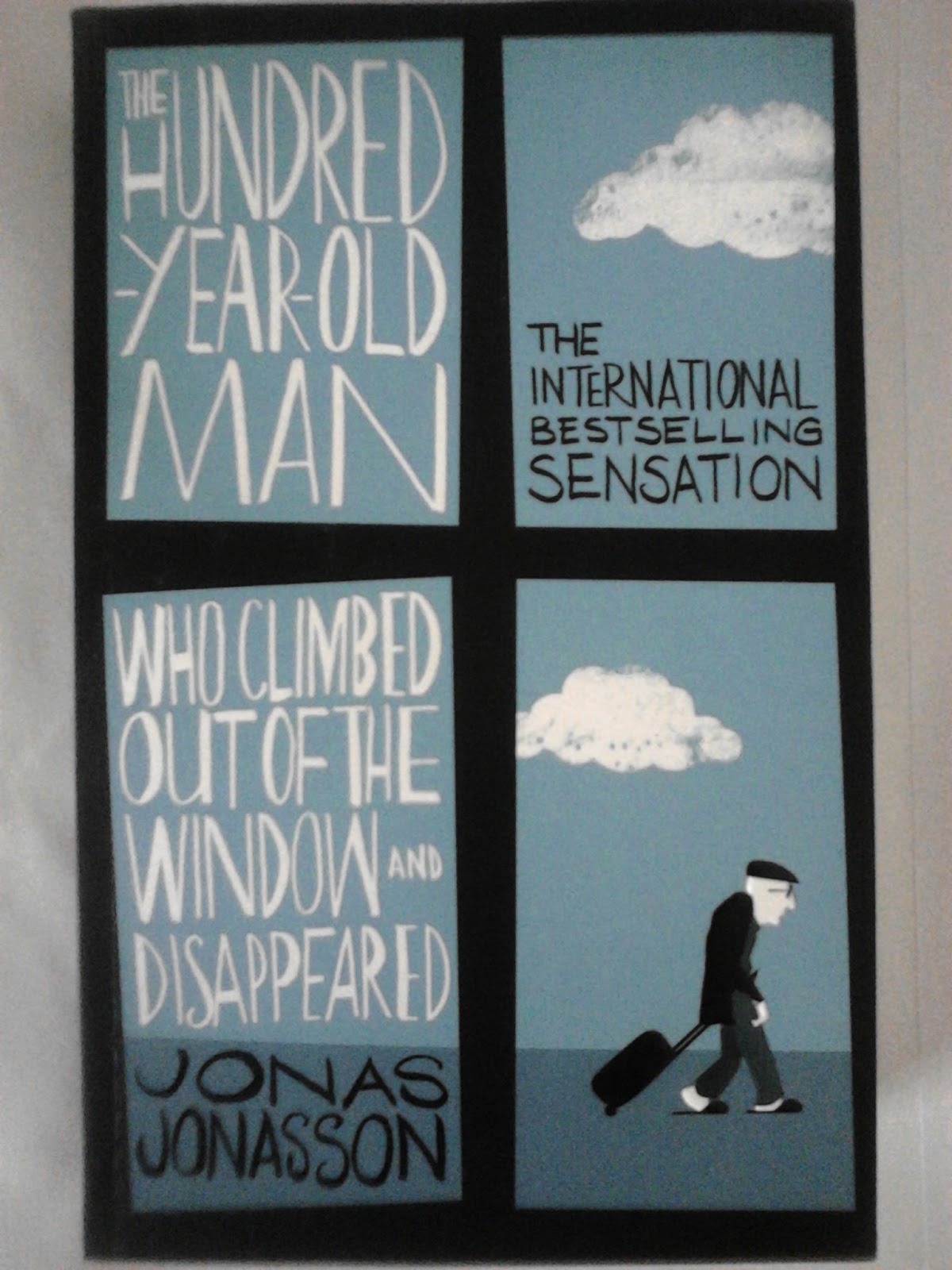
Book review: The Hundred-Year-Old Man Who Climbed Out of the Window and Disappeared by Jonas Jonasson

The Hundred-Year-Old Man Who Climbed Out of the Window and Disappeared by Jonas Jonasson
(my own photo)
Just when you think that you have had enough adventure for a lifetime...

On his one-hundreth birthday, Allan Karlsson decides to leave the old people's home.  He climbs out of the window and embarks on a crazy journey, complete with a runaway elephant, a criminal gang, and an almost-doctor.  The story is intercut with details of Allan's eventful life, and his role in some of the most important events of the twentieth century.

The novel was really funny.  The juxtaposition between Allan's direct, matter-of-fact outlook and the sometimes wacky, sometimes world-changing events he is involved in was very entertaining.

I really enjoyed the characterization of Allan. It's really rare to see an elderly person as the central protagonist of a novel.  More often then not, they're someone's wise mentor, or someone looking back on their eventful, younger years.  Allan was a really fun character, and I enjoyed reading about him.

Chance of finding it in my imaginary bookstore? 95%

Thursday, March 21, 2013

Double Feature: Death of a Salesman and No-one Makes You Shop at Walmart

I just realized that it's almost April, and I haven't written a single post this month.  Even though I'm ridiculously busy right now, I think I'll just get busier as the month goes on.  So, even though I have had absolutely no mind-blowing, incredible, amazing, earth-shattering ideas for posts, I think I'll just write a quick piece on the two books I've read this month so far.

The first one is Arthur Miller's Death of a Salesman.  I absolutely loved this play. The writing was really incredible; it was much shorter than a novel, but every sentence had so much weight. I can't decide whether I prefer this to The Crucible, but I don't think that matters.  When I start comparing work by the same author side by side I always end up not liking one of the texts as much as I had before, because I realize that even though one might be great, it's not quite as good as the other.

Sunday, February 10, 2013

Book review: Thinking Fast and Slow by Daniel Kahneman

Recently, I was quite worried that I was writing too many book reviews, and that I should spend more time on other topics.  However, I have come to the startling realization that I haven't written a review since September.

So, I've decided to review Daniel Kahneman's Thinking Fast and Slow, partially because I saw it on display in the bookshop, and partially because it was released fairly recently, so reviewing it seems slightly less passé.

Thinking Fast and Slow by Daniel Kahneman
(my own photo)
Kahneman's book is based on the idea that while humans are traditionally seen as rational creatures, we do a lot of irrational things.  So far so obvious, but Kahneman does more than just give a list of all the most illogical things we do. His book focuses on psychological research into heuristics, or mental shortcuts, and how they sometimes cause us to make poor decisions.  Much of the research is his own, but it's not the sole focus of the book.

It's really interesting to have someone writing about their own research.  Books that are this accessible to the lay reader are generally written by science writers.  While there is nothing wrong with that, I enjoyed the fact that we got it "straight from the horses mouth".

As I mentioned, the book is aimed at the lay reader, and the language is straightforward.  At the same time, I never got the sense that it was oversimplified or dumbed-down.  Kahneman seems very conscious that his work does have practical implications, and he is very keen to highlight them.

Overall, I thought it was a brilliant book.

That being said, I think that Part IV: Choices dragged a little bit.  It was probably due to the fact that the examples used were so similar, which meant I had several bouts of déjà vu.

Chances of finding it in my imaginary bookstore? 65%

Sunday, September 9, 2012

Book review: A Room with a View by E.M. Forster

A Room with a View by E.M. Forester
(my own photo)
At the beginning of the summer, I set myself the admittedly slightly unrealistic goal of reading fifty books.  Now that the holidays are almost officially over, I can say with confidence that I'm not going to achieve that goal.  However, I did manage to read a lot of really great books, some of which I have been meaning to read for ages, and this is one of them.

A Room with a View is the story of Lucy Honeychurch, who travels to Florence chaperoned by her cousin, Charlotte.  When they complain about the fact that their room in the hotel doesn't have a view of the river, Mr. Emerson and his son George offer to swap places with them.  While Mr. Emerson sees it as a gesture of kindness, it is not seen as the "proper" thing to do.  Lucy has many interesting experiences while in Italy, including getting lost while sight-seeing, witnessing a murder, and going into the surrounding hills.  This holiday shapes her perspective on the world and her future actions.

Overall, it was an incredible book.  I thought that the characters were all very memorable and varied.  The relationship between Lucy and George was really romantic and I thought that it was beautiful.

While it didn't really have the satirical edge of Jane Austen, the social commentary was still really effective.  Sadly, too many of the issues that Forester discusses are still relevant today.

In conclusion, this novel is amazing in so many different ways, it has stood the test of time for all the right reasons.

Chances of finding it in my imaginary bookstore? 95%

Monday, August 20, 2012

Book review: Pastwatch: the Redemption of Christopher Columbus by Orson Scott Card


Pastwatch: the Redemption of Christopher Columbus
 Orson Scott Card
(my own photo)
I would like to start out this post by thanking my friend for lending me loads of awesome books, including this one.
This book is set in the future; humankind has nearly destroyed the Earth, but are now starting to rebuild society.  One way of rebuilding is through Pastwatch, a group of historians who use a machine called Tempoview to look into the past.  However, some historians believe that they should go further; that they should try and go back in time and make the world a better place by altering the results of the voyage of Christopher Columbus.

I thought that this book was really exciting, and the pacing was really good.

The idea of letting people see into the past and to travel through time isn't by any means unique, but I think that it was very well thought out.  I really enjoyed the comments about the technical side of the machines used to look into the past.

One part of a novel that can be really make or break for me are the characters, and personally I found the characters in this novel to be lacking.  Too many of the characters were completely flat and flawless.

Then there was the alternative history.  Now, I don’t pretend to be a historian or an expert on Columbus, but this book seemed to suggest that if Columbus’ voyage were somehow changed that the world would become a better place at virtually no cost.  The Columbus legacy is really complicated and I don't think that the treatment of the topic was sufficiently nuanced.  Also, if the goal of these historians was to make the world a better place with less suffering and slavery, then why didn't they go even further back in time and prevent slavery from being invented? Time travel is difficult to write about, and I don't think that this book dealt with the topic particularly well


Chance of finding it in my imaginary bookstore: 60%

I wrote this post before I knew about Orson Scott Card's attitude towards homosexuality.  I think that it is unacceptable, and this blog post was in no way meant to suggest that I condone this.

Chance of finding it in my imaginary bookstore? 0%


Monday, August 6, 2012

Book review: Here Lies Arthur by Philip Reeve

Here Lies Arthur by Philip Reeve
(my own photo)
Arthur is arguably the most famous British king; the brave, noble warrior whose deeds have been celebrated for centuries.  But in Reeve's novel the real-life Arthur is nothing like the Arthur of legend.

Shortly after Arthur, a brutal, petty tyrant, burns down a village, Gwyna, a young girl who lived there, is taken in by the mysterious Myrddin.  He spins stories of Arthurs greatness in the hope rallying support for the man he believes can defeat the Saxons and unite Britain.  Gwyna becomes involved in making these legends and learns the power of words and suggestion.

While the writer makes it clear that this is just his own interpretation of the legends, I did enjoy the way he went against the hero-worship that traditionally surrounds Arthur.  However, I think he may have even gone too far in the opposite direction, and I don't think that the Arthur character in this novel had enough redeeming features to make him seem real.

It was an exciting, fast paced novel, and I felt that it dealt with issues such as the power of words and social constructs surrounding gender in an interesting, accessible way.

I think that this book is probably best suited for readers from 10-15 years of age.

Chances of finding it in my imaginary bookstore: 60%

Sunday, July 8, 2012

Book review: Sister by Rosamund Lupton

Sister by Rosamund Lupton
(my own photo)
The bond between sisters is incredibly deep. I don't think that there is anyone else in the world who can get me to play as many games of Monopoly as my sister can.

Bee and Tess, the sisters in Rosamund Lupton's Sister appear to be total opposites. Bee is a nice person with a nice fiancee and a nice job and a nice life, all of which is...well...boring.  Tess is an rebellious, free-spirited art student.  However, when Tess is found dead, Bee sets out to prove that she was murdered, and to find the culprit.  Throughout this book, Lupton explores the bond between these two very different sisters.

I thought that this book was very well written, and that it is more reflective then the vast majority of crime novels.  There were many exciting twists and turns, and the plot was very detailed.

I thought that the ending was a little bit of a let down for me.  Lupton unleashes many surprises throughout the novel, and most of them were hair-raising.  However, I found that the twist at the end lacked credibility.

Chances of finding it in my imaginary bookstore: 80%

Sunday, July 1, 2012

Book review: The Five People You Meet in Heaven by Mitch Albom

The Five People You Meet in Heaven
(my own photo)
It was late, the bookshop was closing, and I had to make a decision; would I buy Pyramids or The Five People You Meet in Heaven?  Even though I love Terry Pratchett, I'm glad I chose The Five People You Meet in Heaven.

This book is centered around Eddie, a war veteran who works in an amusement park.  After he dies, he goes to a version of the afterlife where he meets five different people, all of whom help him come to terms with his life and death.

The premise was really intriguing, and very well executed.

I thought that all of the characters were really well-written. They all had a great deal of depth, despite the fact that many of them appear only briefly.  I found the protagonist, Eddie, sympathetic and relatable.

The Five People You Meet in Heaven is a truly riveting read; I finished most of it in the course of one afternoon.

One could argue that the book contains a few coincidences that seem too improbable to be true, but I would argue that this is intentional.  Our lives are full of strange coincidences, whether we realize it or not, and all of our actions have a profound effect on others, many of whom we don't know.


Chances of finding it in my imaginary bookstore: 95%